Showing posts with label vegetarian. Show all posts

Monday, October 31, 2016

Deconstructed Pesto Pasta Primavera


Want pesto, but not all the oil? Chop and add all of the traditional pesto ingredients plus just enough oil to flavor. Pro tip: the addition of parsley helps to keep this “pesto” green. It’s not essential, but your pesto will turn brown shortly after preparing if you leave the parsley out.

Ingredients:
3/4 pound rotini pasta, any type
2 tablespoons olive oil, plus extra for topping (if desired)
2 large garlic cloves, finely minced
1 medium summer squash or zucchini, cut into strips similar in size to the pasta (¼” x  ¼” x 1”)
1 head of broccoli, cut stalk portion in strips (¼” x  ¼” x 1”) and head portion into 1” florets
¼ to ½ teaspoon crushed red pepper flakes, optional
2/3 cup finely chopped basil (do NOT pack when measuring)
1/3 cup finely chopped parsley (do NOT pack when measuring), optional
Juice of ½ a lemon
Salt and freshly ground black pepper, to taste
½ pound cherry or grape tomatoes, cut in half
¼ cup toasted pine nuts, optional

Directions:
  1. Boil pasta in salted water according to package instructions until al dente. If using gluten-free or high protein pastas, rinse pasta at the end of cooking.
  2. Heat olive oil over medium heat in a large skillet. Add garlic and stir; add squash and broccoli before garlic browns and still well. Sprinkle with a couple pinches of salt and pepper. Cook about 5 minutes, stirring occasionally, until vegetables are cooked but broccoli is still slightly crisp.
  3. Add pasta and crushed red pepper flakes to the vegetables and reheat pasta. Add a few tablespoons of water to the pan if the pasta is sticking. Add basil, parsley and lemon juice. Season to taste with salt and pepper.
  4. Portion into bowls and top with tomatoes and pine nuts. If desired, drizzle with a bit more olive oil. 

Makes 4 large servings

Substitutions: You can substitute chopped walnuts for pine nuts. You can also substitute other vegetables—like colored bell peppers, carrots, asparagus, and cauliflower—for the vegetables used in this recipe.


Thursday, October 27, 2016

Red Lentil and Vegetable Soup with Fried Scallions


This soup reheats well, so I make a large batch and store whatever I won’t eat within a weeks’ time in 2 cup containers in the freezer. This makes it easy to take for lunch or reheat for a quick weeknight meal. It is delicious served over brown rice or with whole grain bread, crackers or pita.

Ingredients:
4 tablespoons olive oil*
1 large, or 2 medium onions, ¼ to ½-inch dice
2 stalks celery, ¼ to ½-inch dice
4 medium carrots, ¼ to ½-inch dice
1 cup diced sweet potato, potato, or winter squash
1 cup ¼ to ½-inch diced summer squash or zucchini
6 tablespoons finely minced cilantro stems and roots
1 teaspoon kosher or sea salt
2 teaspoons ground turmeric
1 teaspoon ground cumin
28-ounces tomato sauce (low-sodium, if possible)
2 cups red lentils
2 small limes, juiced
Salt and freshly ground black pepper to taste
8 scallions, sliced thinly on a bias

Directions:
  1. Heat 2 tablespoons of oil in a 6 to 8 quart stock pot over medium-high heat. Add onions, stirring occasionally. If onions begin to cook to quickly and stick or become deep brown in spots, turn heat down to medium.
  2. While onion is cooking, chop and add celery, carrots, sweet potato, summer squash and cilantro stems, 1 teaspoon salt, turmeric and cumin to the pot, continuing to stir occasionally. If the vegetables begin to brown or stick, cover with a lid. Cook for 5 min.
  3. Add tomato sauce, 8 cups of water and lentils. Bring to a boil and then reduce heat to medium-low and cover with a lid; soup should be simmering (lightly bubbling). Cook for 30 minutes. Stir frequently for the first 10 minutes or lentils will stick to the bottom of the pot.
  4. When the soup is nearly done, heat remaining 2 tablespoons of oil in a skillet over high heat. When oil just starts to smoke, add in scallions and stir-fry until the edges crisp and brown slightly. Remove scallions from pan and set aside for garnishing.
  5. Season soup to taste with lime juice, salt and pepper.
  6. Serve soup sprinkled with scallions. Stir remaining scallions into the soup when you’re putting the soup away after dinner.

*If you prefer crunchy scallions, heat enough oil to truly fry the scallions (about 1 cup) and cook the scallions in 2 batches. You can scoop the scallions out of the oil with a slotted spoon and drain on paper towels. Reserve the leftover oil for other uses; it is great for salad dressings, pastas, and drizzled over baked potatoes or roasted vegetables.

Makes: 18 cups (9 bowls)


Sunday, August 21, 2016

Thai Basil Eggplant

At the farmer's market this weekend, tables were overflowing with eggplants of all shapes, sizes, and colors. They were truly a sight to behold in their different shades and combinations of purples, greens, and whites. 


Different varieties of eggplant*

What seasoned cooks view with admiration and awe, is no doubt a source of anxiety and confusion for those starting out in the kitchen or new to eggplant cookery. To make matters worse, any specific type of eggplant may be called different names depending on where you buy it!

Have no fear! 

The key to eggplant is to get the right shape for the recipe that you're making--regardless of color. 

This is because those of the same shape tend to have the most similar taste, texture, and cooking methods. There are certainly subtle flavor differences between the varieties, however, a dish will generally turn out fine if you substitute a similar shape--but different size or color--eggplant variety. 
Thai Eggplant*

Note: an exception is the small, round, green, Thai eggplant. This one is more crisp and has more small, pronounced seeds than the other varieties and is best not substituted.

The following is a home version of Thai Basil Eggplant--a dish you can find in many Thai restaurants. Don't be confused by the name. "Thai" refers to the type of basil used, NOT the type of eggplant. The best eggplants to use for this dish are the long, slender types which are often referred to as Chinese, Filipino, or Japanese eggplants. However, they go by many other names as well. 


Thai Basil Eggplant

Sauce ingredients:
1/4 cup low-sodium soy sauce 
2 Tablespoons sugar
2 teaspoons Hoisin sauce or black bean garlic sauce
1-1/2 teaspoons cornstarch (or slightly less)

Other ingredients:
1-14 oz. package of firm tofu, drained and patted dry with a paper towel, optional
1 pound Chinese eggplant (about 2-3 large), roll cut** 1-inch pieces
1 red bell pepper, cut into 1-inch pieces
2 large cloves garlic, minced (about 2 teaspoons)
3 hot Thai chilies finely sliced or minced
1-2 cups fresh Thai basil leaves***
2 tablespoons vegetable or peanut oil
4 cups cooked brown rice or quinoa for serving

Instructions:

1. If using tofu, preheat oven to 425 degrees Fahrenheit. Then, cut the block of tofu width-wise into 7 slices, cut these in half to make 14 squares, then cut these at an angle to make 28 triangles. On a baking sheet covered with parchment (or brushed with oil), lay out tofu triangles in a single layer, not touching each other. Bake for 30 minutes, flipping halfway through cooking. 

2. Meanwhile, combine 1 1/2 cups water, soy sauce, sugar, and hoisin (or black bean garlic) sauce in a small bowl and stir. In a separate small bowl, combine 1/4 cup cold water and cornstarch; stir to dissolve and set aside.

3. Heat the oil over high heat in a large fry pan or wok; add the garlic and chilies, stir quickly and then add eggplant and peppers. Stir-fry for 2 minutes (or less if garlic starts to brown or burn). Then, add soy sauce mixture and continue stirring over high head until liquid reduces by half and eggplant is tender, about 3 minutes.  

4. Reduce heat to medium. Stir cornstarch mixture and then stir the mixture into the pan. Bring to simmer. Remove from heat and stir in Thai basil. 

5. Serve immediately with brown rice or quinoa.

Makes: 4 servings


What a roll cut vegetable looks like (example: roll cut carrot)*

**Roll-cut means to cut in irregular pieces, generally 1-2 inches in size. This is done by cutting on a bias, rolling the vegetable 90 degrees, and cutting on a bias through the middle of the previous cut. Don't worry, it doesn't have to be perfect. The goal is just to have more edges that if you'd sliced the vegetable because this will make the pieces less likely to stick to the side of the pan while cooking. 
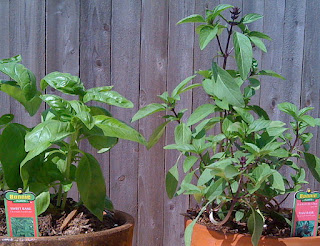

Left=Sweet (aka. Italian) Basil, Right=Thai basil*

***Thai basil looks similar to the sweet, Italian basil that you see in the grocery store, but you can tell them apart because the stems of Thai basil are purple (or at least partially purple) and the leaves are less shiny and rounded than sweet basil. The flavor of Thai basil also has a slight licorice or anise flavor and is more sharp, pronounced than sweet basil.


*Photo credits: (basket of eggplant) veggiegardeningtips.com, (Thai eggplant) vegaproduce.com, (roll cut carrot) finecooking.com, (Thai basil)  By SweetBasilOrThaiBasil0314.JPG: Cchatfieldderivative work: Cchatfield (talk) - SweetBasilOrThaiBasil0314.JPG, CC BY-SA 3.0, https://commons.wikimedia.org/w/index.php?curid=14867551.